
TL;DR:
- Dog waste poses significant health and environmental risks at outdoor events due to high bacteria levels and soil contamination. Managing waste through professional services and well-placed disposal stations enhances guest safety, experience, and venue preservation. Proper planning and infrastructure are essential to prevent reputation damage and ecological harm from unmanaged dog waste.
Dog waste is one of the most underestimated threats to a successful outdoor event. Most people assume it’s a minor inconvenience — step around it, move on. But why dog waste ruins outdoor events goes much deeper than the obvious. A single gram carries 23 million fecal coliform bacteria, and the contamination lingers long after the pile is gone. For event planners and outdoor enthusiasts who care about guest experience, safety, and venue reputation, understanding this problem is the first step toward fixing it.
Table of Contents
- Key takeaways
- Why dog waste ruins outdoor events: the health and environmental case
- How dog poop at events damages guest experience
- Why waste management gets neglected at outdoor gatherings
- Practical solutions for outdoor event cleanliness
- Advanced tools and services for waste control
- My take on what planners consistently get wrong
- Keep your next event clean with Thepoopinator
- FAQ
Key takeaways
| Point | Details |
|---|---|
| Bacteria levels are alarming | One gram of dog waste contains up to 23 million fecal coliform bacteria, posing real health risks to guests. |
| Soil stays contaminated | Even after visible waste is removed, parasite eggs and bacteria persist in soil at event sites. |
| Guest experience suffers | Odor, visual mess, and safety concerns from dog poop directly damage attendee satisfaction and event reputation. |
| Misconceptions drive neglect | Many owners believe waste decomposes harmlessly, which leads to poor compliance at outdoor gatherings. |
| Professional services solve it | Hiring specialized pet waste removal before and after events is the most reliable way to protect guests and venues. |
Why dog waste ruins outdoor events: the health and environmental case
The impact of dog waste goes well beyond what you can see or smell. When dog poop sits on grass at a park, festival, or outdoor venue, it becomes a contamination source that affects soil, water, and the people walking through the space.
The bacteria and parasite problem
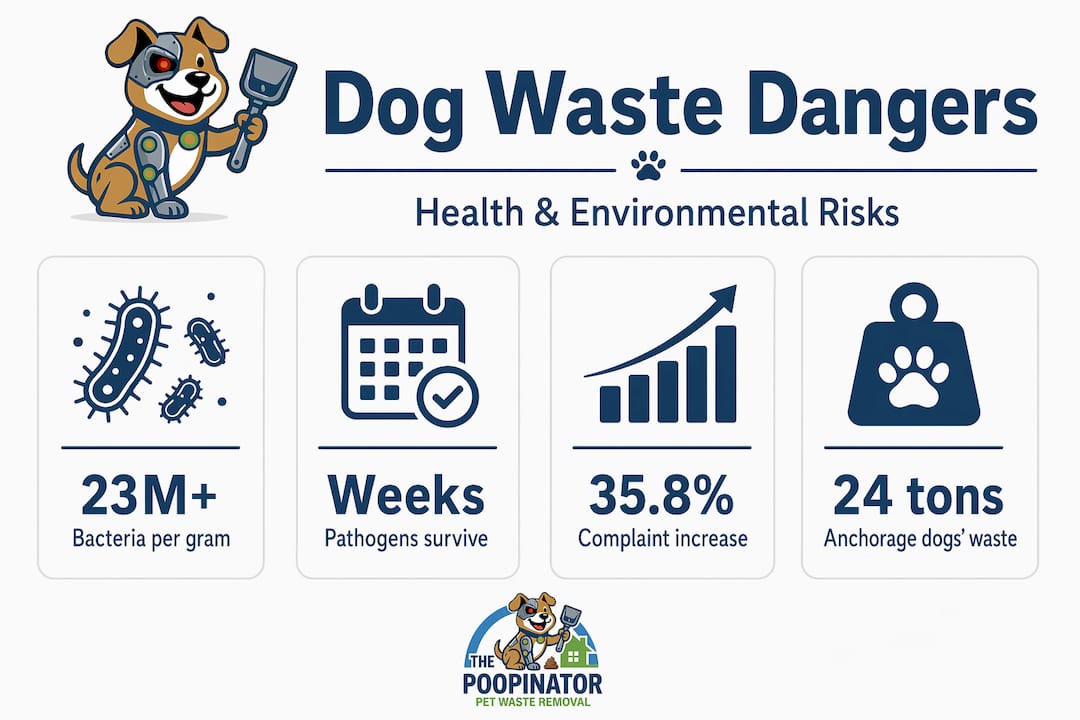
Dog waste carries a range of pathogens that are genuinely dangerous to humans and other animals. Beyond fecal coliform bacteria, it can contain Salmonella, E. coli, Campylobacter, and parasites like roundworms, hookworms, and Giardia. Children playing on contaminated grass, guests sitting on blankets, and dogs sniffing around are all at direct exposure risk. At an outdoor event with dozens or hundreds of attendees, that risk multiplies fast.
What makes this worse is that soil stays contaminated with viable parasite eggs and resistant bacteria even after the visible waste has been picked up. A venue that looks clean can still be a health hazard. Event organizers who rely on a quick visual scan before opening the gates are not catching the full picture.
Water contamination from storm runoff
Here is where the environmental damage gets serious. When it rains before, during, or after an outdoor event, waste residue washes off the ground and into storm drains, creeks, and local waterways. Nitrogen and phosphorus from dog waste fuel algal blooms that deplete oxygen in water bodies, killing fish and disrupting aquatic ecosystems. For events near parks, lakes, or green spaces, this is not a hypothetical risk. It is a documented pattern.
Cities are taking notice. NYC reported a 35.8% rise in dog waste complaints, and Anchorage dogs produce over 24 tons of waste daily. The scale of the problem at the municipal level reflects exactly what happens in miniature at any outdoor gathering where waste management is not prioritized.
A quick look at the key pathogens
| Pathogen | Risk to humans | Survival in soil |
|---|---|---|
| E. coli | Gastrointestinal illness | Up to several weeks |
| Salmonella | Fever, vomiting, diarrhea | Weeks to months |
| Roundworm eggs | Organ damage if ingested | Years |
| Giardia | Severe digestive distress | Weeks in moist conditions |
Pro Tip: Set up pet waste stations at every entry point and along walking paths before the event starts. Guests are far more likely to clean up after their dogs when bags and bins are within arm’s reach.
How dog poop at events damages guest experience
The health risks are serious, but the damage to guest experience is often what event planners feel first. Outdoor event cleanliness is one of the top factors guests use to judge whether they had a good time and whether they will come back.
Unmanaged dog waste creates three immediate problems for attendees:
- Visual contamination. Visible piles scattered across a lawn or pathway signal poor organization. Guests notice, and they remember. A single photo posted to social media can define how an event is perceived by people who were not even there.
- Persistent odor. On a warm day, the smell from even a small amount of dog waste spreads quickly. It is difficult to ignore and nearly impossible to neutralize mid-event without removing the source.
- Safety concerns. Guests stepping in waste, children falling near contaminated areas, and dogs tracking bacteria onto blankets and equipment all create genuine liability exposure for organizers.
The reputation damage is real. Elevated bacteria counts can trigger formal complaints and even nuisance claims against property managers and event organizers. One poorly managed event can cost future bookings, venue access, and sponsor relationships.
Grass damage is another factor planners often overlook. Dog urine and waste burn turf and create dead patches that reduce the usable, visually appealing area of a venue. For events that rely on open lawn space for seating, games, or vendor setups, that lost square footage has a direct cost.
Why waste management gets neglected at outdoor gatherings
Understanding why dog waste affects outdoor gatherings starts with understanding why people do not manage it better in the first place. The barriers are predictable, but they are real.
-
The “natural decomposition” myth. Many dog owners genuinely believe that leaving waste on grass is fine because it will break down like fertilizer. It will not. Dog waste is high in protein and pathogens, not nutrients. It acidifies soil and contaminates it rather than enriching it. Owners sometimes skip cleanup specifically because they believe the waste is natural and harmless.
-
No convenient disposal options. If a guest has to walk 200 yards to find a waste bag or a bin, most will not bother. Lack of accessible disposal infrastructure is one of the most consistent reasons compliance fails at outdoor events. Guests are not necessarily negligent. They are often just unprepared.
-
Off-leash dogs are harder to track. At dog-friendly festivals, off-leash areas, or casual park gatherings, owners lose track of where their dogs have gone. By the time they realize their dog has relieved itself, they may not know where it happened or may not have a bag on hand.
-
Low awareness among planners. Many event organizers simply do not factor pet waste into their planning checklist. They think about parking, permits, and porta-potties. Pet waste stations rarely make the list unless someone has dealt with a problem before.
Pro Tip: Include a short note in your event communications reminding guests to bring waste bags and explaining where disposal stations will be located. Framing it as a community care message gets better results than a rule.
Practical solutions for outdoor event cleanliness
Managing the impact of dog waste at your event does not require a massive budget. It requires planning, infrastructure, and clear communication.
Before the event
Hire a professional pet waste removal service to clear the venue site at least 24 hours before guests arrive. This removes existing contamination and gives you a clean baseline. Services like professional pooper scooper teams are equipped to cover large areas efficiently and dispose of waste in environmentally responsible ways.
During the event
- Place pet waste stations with bags and sealed bins every 50 to 100 yards throughout the venue, especially near entry points, water features, and high-traffic areas.
- Post clear signage at eye level that reminds guests of the cleanup requirement and points them toward the nearest station.
- Assign a volunteer or staff member to monitor high-traffic areas and restock stations as needed.
- Consider designating a specific dog relief area away from food vendors, seating, and children’s activity zones.
After the event
Schedule a professional cleanup sweep immediately after the event closes. Proper waste disposal means bagging and trashing waste rather than leaving it to break down on-site. Even biodegradable bags require specific conditions to degrade properly, so on-site composting is not a reliable solution at most venues.
Comparison: DIY cleanup vs. professional pet waste removal
| Factor | DIY cleanup | Professional service |
|---|---|---|
| Coverage | Inconsistent, volunteer-dependent | Systematic, full-area coverage |
| Pathogen awareness | Low | High, trained for contamination risks |
| Time required | Hours of staff or volunteer time | Handled independently |
| Disposal method | Often improper | Eco-friendly, compliant disposal |
| Post-event soil safety | Not assessed | Part of professional protocols |
Advanced tools and services for waste control
The pet waste management space has moved well beyond a bag dispenser bolted to a fence post. For event planners managing larger venues or recurring outdoor programs, newer solutions offer meaningful advantages.
In-ground disposal units contain waste below grade, limiting surface exposure and accelerating pathogen reduction before collection. These systems are particularly useful for venues with regular dog traffic between events. Biological breakdown additives can also be introduced to reduce pathogen loads in contained waste systems.
Contracted professional services bring the most consistent results for event cleanliness. A specialized team handles pre-event clearing, provides and manages waste stations during the event, and performs post-event cleanup. This takes the entire problem off the event planner’s plate. For venues in Florida and Indiana, Thepoopinator offers local dog poop cleanup with eco-friendly disposal and the kind of local knowledge that makes a real difference in how thoroughly a space gets cleared.
The broader point is that why pet waste spreads at outdoor events often comes down to infrastructure gaps. Professional services close those gaps before they become guest complaints.
My take on what planners consistently get wrong
I have seen event planners put enormous effort into decorations, catering, and logistics, and then completely ignore the ground their guests are standing on. That disconnect is where the problem lives.
What I have learned is that visible cleanliness and actual cleanliness are not the same thing. A venue that looks fine at 8 a.m. can have contaminated soil from the previous week’s dog traffic. Guests walking barefoot, kids rolling around on the grass, and dogs tracking bacteria onto picnic blankets are all real scenarios at well-organized events that simply did not account for what was already in the ground.
The other mistake I see repeatedly is treating waste management as a reactive problem. Planners wait until a guest complains or someone steps in something before they act. By then, the damage to the experience is done. The planners who get this right build waste management into their pre-event checklist the same way they build in restroom access and trash removal. It is not glamorous, but it is exactly the kind of detail that separates a forgettable event from one people talk about for the right reasons.
My honest advice: if your event allows dogs, budget for professional waste removal. The cost is small relative to the risk of a reputation problem or a liability claim. And if you are working with a recurring venue, consider outdoor maintenance partnerships that keep the space in good condition between events, not just the day of.
— Craig
Keep your next event clean with Thepoopinator
Dog waste should never be the reason your outdoor event falls short. Thepoopinator brings over 20 years of combined experience and hundreds of five-star reviews to pet waste removal, with eco-friendly disposal methods and genuine local expertise. Whether you need a pre-event site clearing in Westfield, IN, or a post-event cleanup in Orlando, FL, the team handles it thoroughly and responsibly. Event planners who have used professional services consistently report fewer guest complaints and a noticeably cleaner venue. If you are planning a dog-friendly gathering and want the ground to be as clean as everything else, explore professional waste removal options for your area and get ahead of the problem before the first guest arrives.
FAQ
What health risks does dog waste pose at outdoor events?
Dog waste carries pathogens including E. coli, Salmonella, and roundworm eggs that can infect humans and pets through direct contact or contaminated soil. A single gram contains up to 23 million fecal coliform bacteria, making unmanaged waste a genuine public health concern at any gathering.
Does dog waste really stay in the soil after cleanup?
Yes. Research confirms that even after visible waste is removed, parasite eggs and resistant bacteria remain viable in soil for weeks or longer, continuing to pose health risks to guests walking or sitting on the ground.
How many waste stations should an outdoor event have?
A good rule of thumb is one station every 50 to 100 yards, with additional units near entry points, off-leash areas, and high-traffic zones. Accessible disposal options are one of the strongest predictors of guest compliance with cleanup expectations.
Can dog waste damage a venue’s lawn permanently?
Repeated waste and urine deposits burn turf and create dead patches that reduce usable event space. For venues hosting regular events, consistent professional cleanup is the most reliable way to protect the lawn and maintain a presentable surface.
Why do so many dog owners skip cleanup at events?
Many owners believe dog waste decomposes naturally and harmlessly, which reduces their motivation to pick up. Lack of convenient disposal options at the event site is the other major factor. Both are problems that event planners can directly address with proper infrastructure and guest communication.
Recommended
- Dog Waste Problems in Westfield, IN? Here’s the Pooper Scooper Service That Actually Works – The Poopinator – Professional Pooper Scooper and Pet Waste Removal Service
- News – The Poopinator – Professional Pooper Scooper and Pet Waste Removal Service
- Home – The Poopinator – Professional Pooper Scooper and Pet Waste Removal Service
- Dog Poop Cleanup in Orlando, FL – The Poopinator – Professional Pooper Scooper and Pet Waste Removal Service